
One of the things I’m exploring in this project is how Revelation’s images and rhetoric are deployed in support of whiteness and racism, especially anti-Black racism.
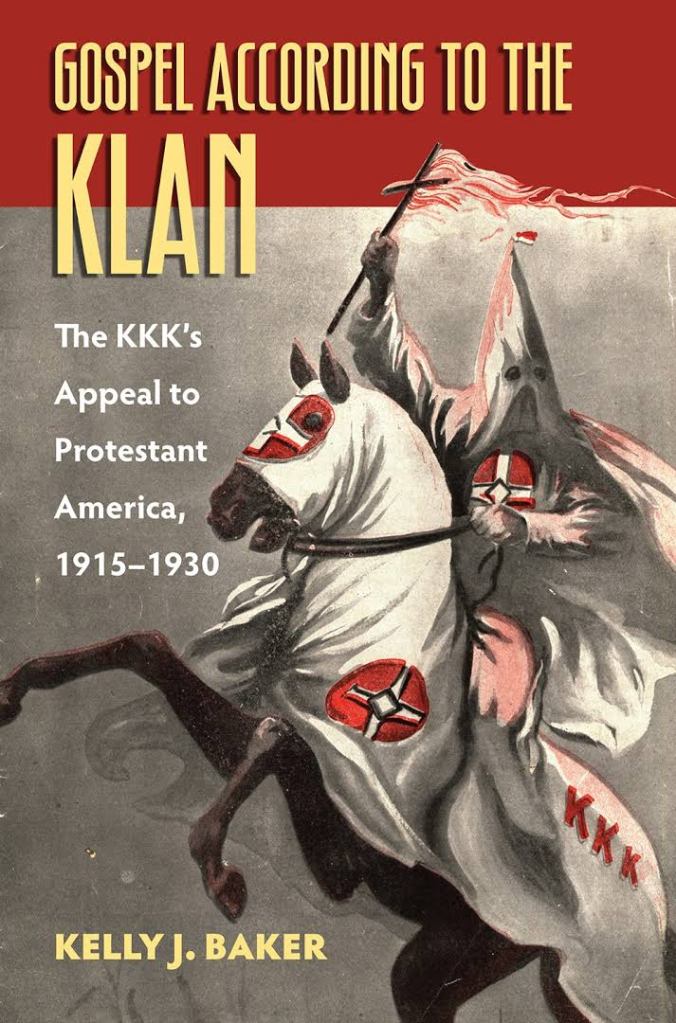
One of the most obvious examples is the use of white robes by the KKK in the early 20th century. This connection is articulated by Kelly J. Baker in her important book The Gospel according to the Klan (2011). You can see this in the quote I pulled above.
Throughout Revelation, white robes are used as a visual sign on faithfulness. The whiteness of the robes is associated with sacrificial death and blood’s “cleansing” power:
Rev 7:13-15: “Then one of the elders addressed me, saying, “Who are these, robed in white, and where have they come from?”I said to him, “Sir, you are the one that knows.” Then he said to me, “These are they who have come out of the great ordeal; they have washed their robes and made them white in the blood of the Lamb. For this reason they are before the throne of God…”
The image on the cover of Baker’s book also evokes the image of Christ as a warrior on a white horse wearing white robes dipped in blood. The red on the Klan robes, Baker explains, evokes blood.
The importance of this book is that Baker demonstrates that the KKK is a form of Protestant Christianity. This is not an endorsement of that particular form of Christian belief. Rather, the point is that understanding the logic of groups like this requires understanding the symbol systems of Christian tradition. Moreover, I’d add that it points to how deeply intertwined Rev is with racist thinking in the US. My hope is that exploring these connections can contribute to dismantling the power of Christian racism.
You can purchase a copy of Baker’s book HERE.
 Lynn R. Huber