I’m currently working on a book project on Revelation and I’m hoping to use this venue as a tool for articulating and organizing my ideas. This work is preliminary, although I hope that some of the ideas I present here will be original and, consequently, I ask that you cite me if you use them in any academic work. TIA.
The project is on Revelation’s color symbolism and how it intersects with both ancient thinking about skin color and people groups (think Benjamin Isaac’s idea of “proto-racism” in antiquity) and how modern interpreters (academic and more popular) deploy this in racialized ways. Specifically, I am interested in bringing to the fore how Revelation has been used in support of Whiteness and anti-Black racism. I think this is especially important in the present moment, as some sectors of the population, especially in the US, are doubling down on White Christian Nationalism.
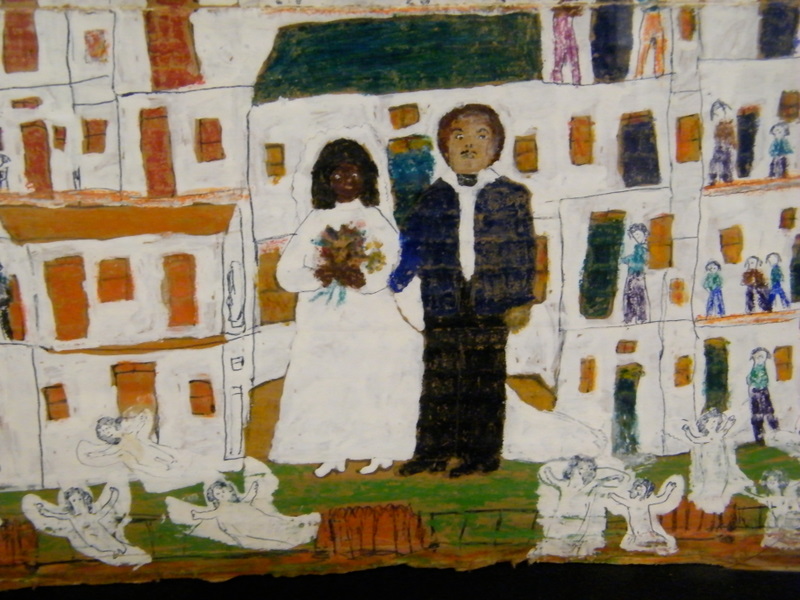
Detail from a Gertrude Morgan illustration of the New Jerusalem, n.d. From the Louisiana State Museums.
One of the images (or set of images) I am thinking about as I embark on this project is Gertrude Morgan’s depiction of herself as Bride with her Bridegroom Christ. She has multiple representations of this, including this one from the New Orleans Museum of Art. I briefly mention this White Jesus in Thinking and Seeing with Women in Revelation (Bloomsbury 2013). I don’t really do enough with it there, since I wasn’t thinking explicitly about race (which I think is a problem). Even though this present project is not about Morgan’s work specially, these images will be in my mind as I write.
In a future post, I’ll say a bit more about color and Revelation’s image of God/ Christ.
I’m currently looking at illustrated Bibles to understand how Revelation’s throne room is depicted visually. In the process, I stumbled across a visual representation of one of my favorite Revelation “side quest” topics-John’s status as Jesus’ beloved as a reason behind Revelation.
As you may or may not know, the Fourth Gospel, long believed to have been authored by John, references a “disciple that Jesus loved” (20:2; 21:20). This disciple is the one who reclines on Jesus’ breast at the Last Supper, and from the cross, Jesus establishes a familial connection between his mother and the beloved, an in-law kind of relationship (19:26-27). Finally, the “beloved disciple” claims gospel authorship in 21:24.
Even though the gospel does not use the term used for “beloved” in ancient Greek homoerotic/ pederastic relationships, the language can be read in erotic terms. Put another way, the text potentially gestures toward a romantic relationship between Jesus and the disciple.
Christ and Saint John the Evangelist, Germany, 1300–1320. Cleveland Museum of Art.
As discussed by medievalist Jeffrey Hamburger in his book St. John the Divine: The Deified Evangelist in Medieval Art and Theology (2002), some medieval traditions add to this by suggesting that the Wedding at Cana, where Jesus turns water into wine, is John’s wedding. However, John ditches his betrothed to follow Jesus in virginal devotion. This tradition is visually evoked in depictions of John as young or virginal. People often think he looks like a woman, as in da Vinci’s Last Supper, where people (ahem, Dan Brown) have confused John with Mary. Nope. John is simply depicted as Jesus’s beloved or younger lover.*
And, here is where Revelation comes in . . . some medieval interpreters believe Jesus grants John the Revelation because of this closeness. Revelation is a gift from lover to beloved.
I’d mostly considered this a medieval tradition, but I found it referenced in an illustrated Bible from 1889, written by Louise S. Houghton and published by the American Tract Society. You can find the Bible on the Internet Archive (see below).
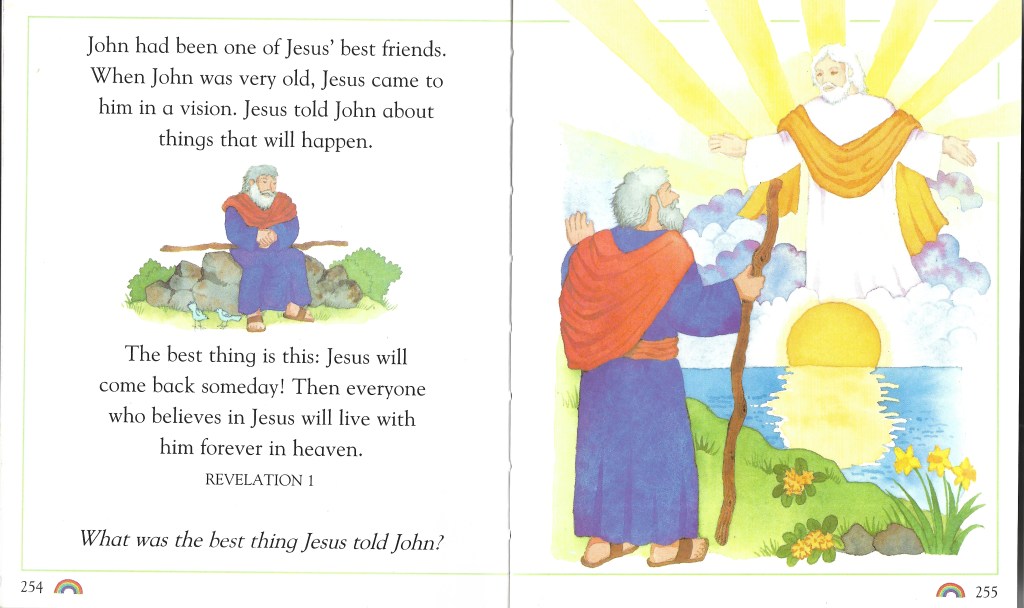
Moreover, the story of John being Jesus’s “special friend” as a reason for John’s visionary experience finds its way into at least one contemporary children’s Bible. Hmmmm . . . .
A Child’s First Bible, Kenneth N. Taylor, Tyndale House, 2000.
*If you find the medieval traditions about John and Jesus interesting, check out Hamburger’s book or take a look at my book Thinking and Seeing with Women in Revelation (2013).
One of the things that brings me joy is art-making.
Arts and crafts have always been a part of my life. My mom and her sister were both avid crafters, and their mom (my grandma Klaus) did exquisite crochet. My dad’s mom was also a crocheter and knitter, so crafting was on both sides of the family.
Aunt Lois wearing a skirt she embroidered.
My aunt’s favorite medium was embroidery (see the picture of her in a skirt she embroidered), and she would embroider things that my grandma crocheted, like pillowcases.
My mom’s crafting repertoire was a little more eclectic and less traditional. She did tole painting, felted crafts, and made small art pieces with driftwood, shells, and lichens she found at the coast. She also did paper mache, making puppets and sculptures to display in the elementary school where she was a librarian. Every summer my aunt, two friends of my mom (two unmarried women who lived together and were maybe queer), and grandma spent a week at the beach with my mom and me to craft, sew, embroider, etc. It was like craft camp. One year I even made us a camp flag out of an old dishtowel that I decorated with a drawing of a sea monster.
In junior high and high school, I really thought I would be a visual artist when I grew up. I didn’t pursue that. There have been times when I’ve felt regret about that, but being an artist wasn’t something people around me did as their primary way of making an income. That isn’t to say it was solely for fun or personal fulfillment. They definitely made art and crafts to see. The craft-fair scene was a total side-hustle. I’ve tapped into that at times with my off-again, on-again Etsy shop. Mostly, the money I make and, I presume, the money they made went toward financing their crafting habit.
Sometimes, my art-making falls by the wayside. I get busy or tired and just feel uninspired. There have been times when I’ve been really active. Usually, those moments coincide with feeling overwhelmed with school, work, and life.
In fact, here’s a zine I started making in grad school.
More recently, zine-making has been a way of cultivating a regular craft practice and an opportunity for self-reflection and practicing gratitude. For the past few years, I’ve made zines in the morning instead of using a daily planner or journal. Every week or every five days, whichever works for me, I make a mini-zine in which I write out gratitudes, to-do lists, schedules, etc.
Here are a few examples, including a glimpse into my very un-systematic day-planning.
The zine covers vary quite a bit. Sometimes, I’ll pull a card from an oracle deck and use that as inspiration for a drawing and a thought I want to carry with me during the week. Sometimes, the covers are related to what’s going on in my life. Other times, they are generic.
I generally carry my weekly zines with me in a bag, backpack, or coat pocket. Having it with me connects me to the art and to my current moment in time.
At significant moments in time, such as the beginning of the new year or end of the semester, I’ll do a special zine in which I reflect or set intentions.
Sometimes, I’ll use them instead of a program book at my annual professional meeting.
One of the things I like about zines is their DIY nature. Modern queer/ feminist zine culture really emerged in the 1980-90s as part of the Riot Girl movement. (Here’s a brief zine history.) They were an easy way of sharing information, ideas, images, etc. Find yourself a photocopier (remembers Kinkos?) and you were good to go. You could put out a zine at the same time as you were making quarter-sheets to hand out for a band. Since zines are self-published and produced, they offer little glimpses into micro-cultures.
If you’re interested in reading zines, a lot of libraries carry them or have them in their archives. There are also several digital zine archives. If you want to support zine artists, you can check out a zine distro and buy some. Zines can often be purchased at indie book or record stores and at various zine fests.
If you’re interested, here are a couple of sites to check out:
Ancients operated with two general theories of vision. The intromission theory was based upon the idea that objects emitted effluences which moved through the air and impacted the eye. This idea is associated with Aristotle, and Democritus has a similar view. Democritus thought objects were comprised of atoms and the arrangement of atoms influenced whether a viewer saw an object as light or dark. In the case of things comprised mainly of the element of fire, the object would appear luminous.
Plato’s understanding of vision differs as he generally imagines a stream of fire emanating from the individual’s soul and through the eyes to “touch” an object. This is called the emission or extramission theory of vision. At the same time, Plato understands color as a kind of flame emanating from an object. Like Democritus, Plato is concerned with the shape and arrangement of the elements which comprise a thing. The differences in shape and arrangement change the nature of fire emanating from an object and, therefore, mean the viewer’s sight interacts differently with these different emanations. In fact, among the colors noted by Plato is “bright,” which we might think of as more of a quality of a color and not a hue.
Plato’s understanding of extramission and an object’s fire ultimately explains why people perceive colors differently. In other words, for Plato things have a kind of color intrinsic to their substance, but the viewer plays a role in perception. Moreover, colors can be dynamic and shifting. In fact, the word for purple was related to the word for swirling, according to Maria Michela Sassi.
Why does this matter for Revelation? 1. I think the material connection between things and their color (I talked about this in a previous post) helps us understand how ancients connected color and the nature of a thing. 2. Plato’s understanding helps us understand the dynamic aspects of John’s description of things that are bright.
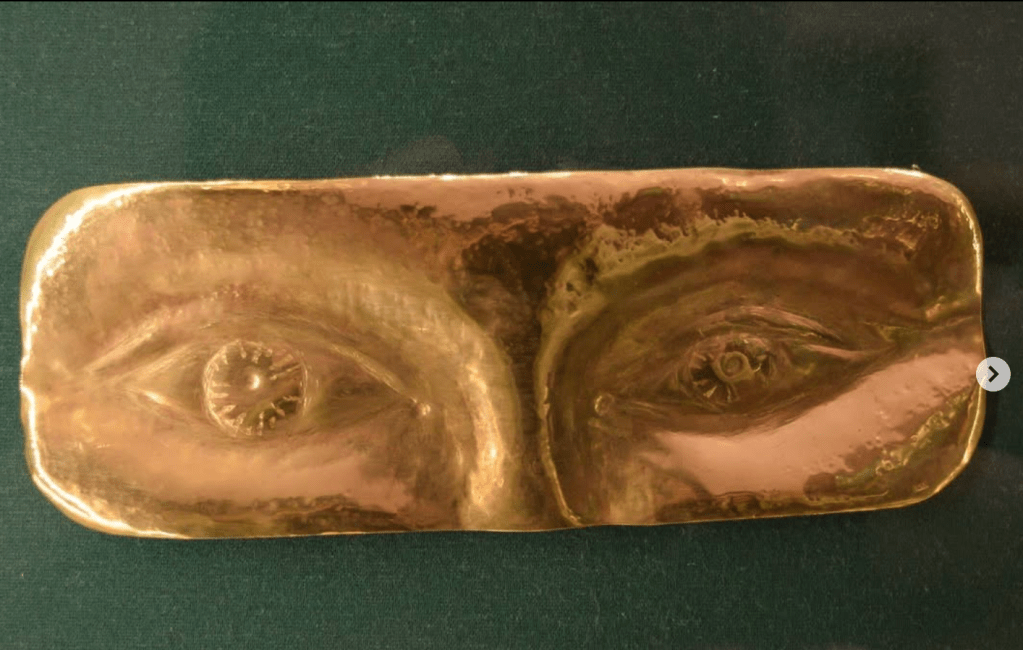
Images: 1) St. Lucy ex voto, Siracusa 2) burning candles 3) eyes of Roman statue head in Museo Nazionale, Roma 4) Roman glass, Aquileia.
One of the things I’m exploring in this project is how Revelation’s images and rhetoric are deployed in support of whiteness and racism, especially anti-Black racism.
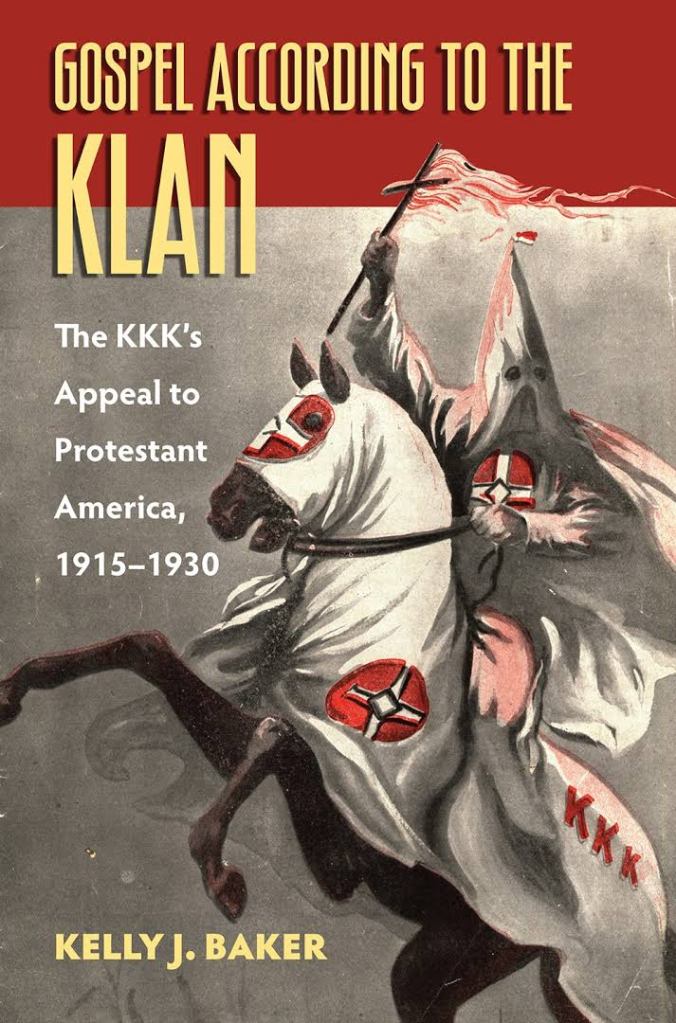
One of the most obvious examples is the use of white robes by the KKK in the early 20th century. This connection is articulated by Kelly J. Baker in her important book The Gospel according to the Klan (2011). You can see this in the quote I pulled above.
Throughout Revelation, white robes are used as a visual sign on faithfulness. The whiteness of the robes is associated with sacrificial death and blood’s “cleansing” power:
Rev 7:13-15: “Then one of the elders addressed me, saying, “Who are these, robed in white, and where have they come from?”I said to him, “Sir, you are the one that knows.” Then he said to me, “These are they who have come out of the great ordeal; they have washed their robes and made them white in the blood of the Lamb. For this reason they are before the throne of God…”
The image on the cover of Baker’s book also evokes the image of Christ as a warrior on a white horse wearing white robes dipped in blood. The red on the Klan robes, Baker explains, evokes blood.
The importance of this book is that Baker demonstrates that the KKK is a form of Protestant Christianity. This is not an endorsement of that particular form of Christian belief. Rather, the point is that understanding the logic of groups like this requires understanding the symbol systems of Christian tradition. Moreover, I’d add that it points to how deeply intertwined Rev is with racist thinking in the US. My hope is that exploring these connections can contribute to dismantling the power of Christian racism.
Aristotle discusses color in two main texts, On the Soul and On the Senses. There is a text titled On Colors attributed to him, but it is likely by a follower. On Colors begins with an affirmation of Empedocles’ insight on the connection between the four elements and colors, whereas in On the Soul and On the Senses Aristotle articulates a more dynamic view of color, imho.
For Aristotle color fills and makes visible the transparent. The idea of transparency may seem odd when thinking about color, since we generally equate transparency with lack of color. However, for Aristotle, color by its very nature, color “can produce movement in that which is actually transparent.”
There is some disagreement about how Aristotle understands transparency. He might just mean things like water, air, and solid objects like glass and crystal. But professor of ancient philosophy Katerina Ierodiakonou notes that in On the Senses Aristotle implies that all objects can be understood as transparent and that color fills the transparent in a way that the boundaries or limits of an object can be seen. The color makes the limits of a defined object apparent.
In the case of things that are undefined and more transparent, such as water or air, a person can see brightness and/ or darkness. These qualities, which Aristotle identifies as color, shift depending upon the viewer’s distance from them, their depth, etc. In some sense, more transparent things, which hover between brightness and darkness, help us recognize that all colors are a mixture of light and dark. As Ierodiakonou explains, for Aristotle objects that are more transparency appear white, since they allow in some brightness (fire and air), while objects that are not at all transparent appear black.
Images: 1) Roman Glass from Pompeii (Naples Arch Museum); 2) Crystals. Cefalu, Sicily. 3) A Roman glass vessel in the shape of a fish that is yellowish in color. British Museum. 4) Brightness and darkness in transparent colored glass. Bodrum, Turkey. 5) White agate intaglio with Athena and Mercury, Istanbul Arch Museum.
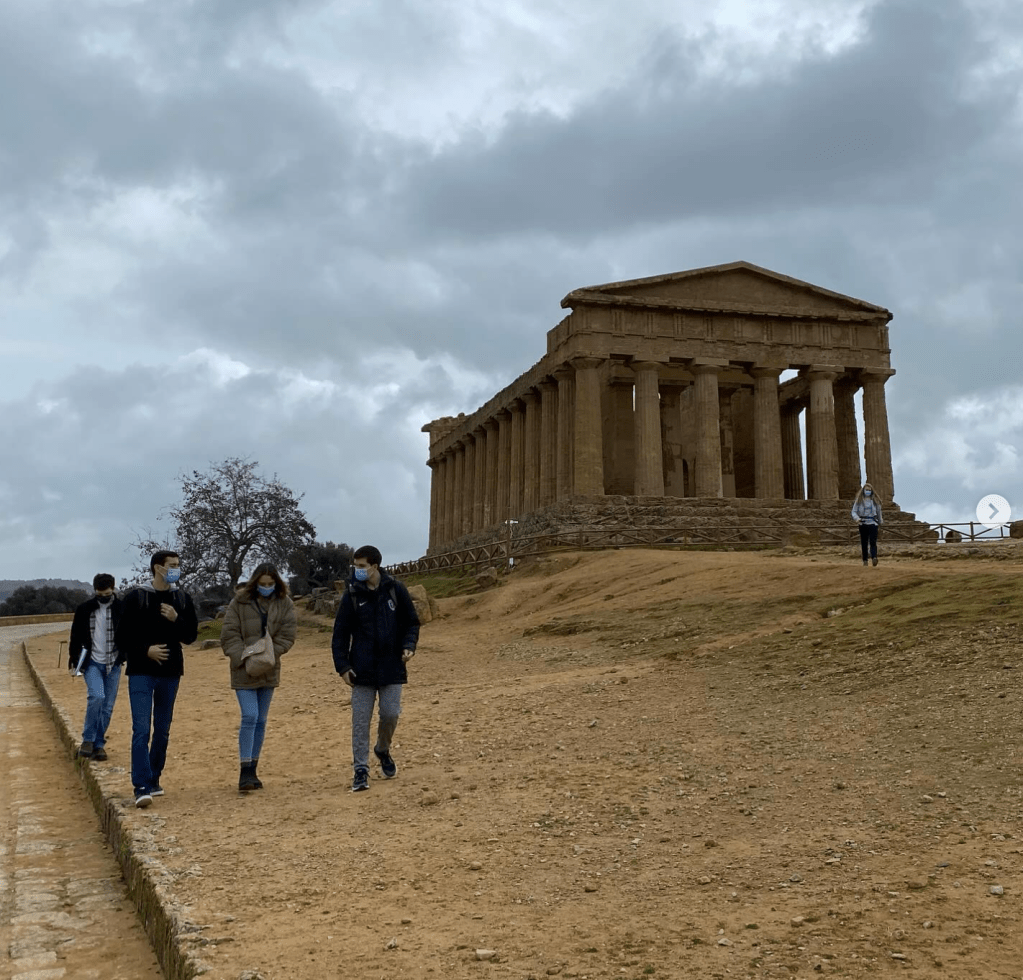
One of the first Greek philosophers to discuss color is Empedocles (c. 484-424 BCE) from Akragas (aka Agrigento) in Sicily. Unfortunately, with the exception of a possible fragment of his work Physika, his work comes to us primarily via citations by others. There are modern collections of work related to E. (including in a Loeb volume) including accounts of his life and teaching, citations of his works, and interpretations of or commentary on his work.
Among the most important ideas attributed to E. is the notion that all things are comprised of four roots or elements—fire, earth, air, water. These elements contribute to the color of things.
At least one ancient author quotes E. as identifying four colors (black, white, red, yellow), which would correspond neatly to the four elements. However, elsewhere in his extant writing E. only refers to black and white, linking them to water and fire respectively. Ironically these are not considered colors, strictly speaking, within the Newtonian understanding of color. However, they are fundamental to ancient color theory.
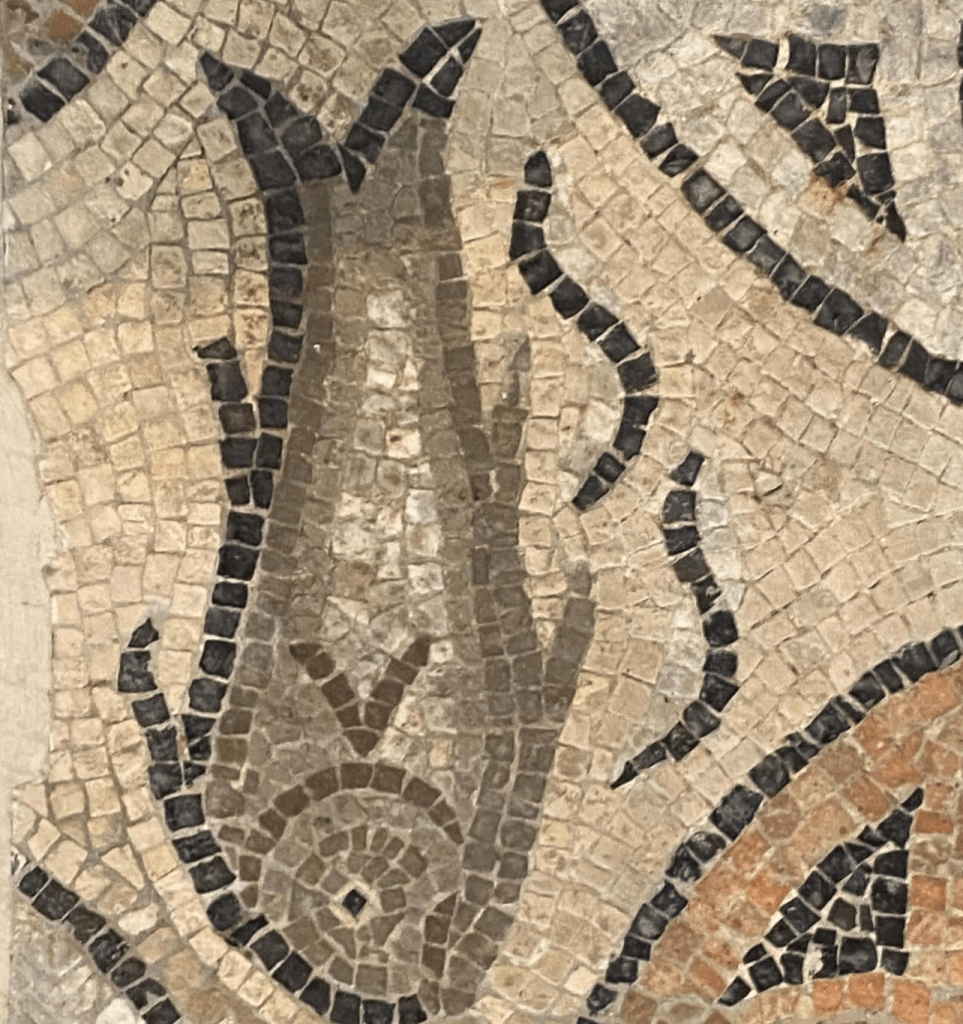
E. compares the creation of things from the elements to an artist who “mixes” colors. Professor of ancient philosophy K. Ierodiakonou explains that “mixing” should not be understood like blending. Rather, it refers to putting colors side-by-side. In some sense, this is similar to how the tiles of a mosaic are laid next to each other. Mosaicists were able to create the illusion of shading the this way. In other words, the elements that make up matter are not diminished or diluted when mixed to create another thing. For instance, E. explains that bones are 4 parts fire, 2 parts water, and 2 parts air. Because they are mostly fire, they appear white.
Images 1) skeleton mosaic from Pompeii; 2) a simple mosaic of a fish shows how placing different color tiles next to each other creates the illusion of dimension; 3) mosaic floor from Pompeii with the four colors supposedly mentioned by Empedocles; 4) classical Greek temple in Agrigento.
Since I teach courses in Religious and Jewish studies at the university where I work, I was asked to be a roundtable discussant at a teach-in on the current conflict in the Middle East. The idea for the event was to have faculty members from a variety of disciplines (Religious Studies, Political Science, Journalism, Economics, Art History, World Languages and Cultures, Geography, etc.) offer a brief intro to their disciplinary perspective on the conflict and then lead a conversation with the 7-9 students at the table. After about 20 minutes, students would move on to another table and topic, participating in three conversations in the 1.5-hour event. Around 250 students attended and the conversations, according to most of the discussants, were fruitful.
On Wednesday morning, I was not looking forward to the table discussions. The day before a hospital in Gaza was bombed and there were conflicting stories about the source of the missile. This made the situation even more raw and complicated than the day before. Another colleague from my department shared a similar sentiment, wishing that there weren’t conflicts like this to discuss, and we talked about how these kinds of events are ultimately what we are here to do—the religious studies professor’s raison d’etre. Among our responsibilities as scholars of religion is to complicate how religious worldviews are constructed and contribute to a world filled with conflict, oppression, and violence. Of course, knowing this does not make our job any easier.
Honestly, I was anxious about the teach-in because, as someone not immediately connected to Israel/ Gaza but with friends and colleagues with deep connections in both places, I was afraid of misrepresenting the motivations of others. I was wary of causing harm by misspeaking. However, as I waited for students to come to my table, I realized that probably the most authentic thing I could do was to speak out of my own experience and from my own social location. I didn’t scrap my topic, “Ancient Claims to and Conflicts over the Land,” but I tied this to the Christian appropriation of Jewish sacred texts about the “promised land” and Christian supersessionism.
As someone who grew up in an evangelical Church, I have heard all my life that God blesses whoever blesses Israel and curses whoever curses Israel. Even though the biblical texts cited for this idea, Genesis 12 and Numbers 24, predate the modern state of Israel, evangelical Christians seemingly see these texts as a foundation for US foreign policy. In fact. according to a 2013 Pew Research Center poll, the percentage of US Christians who believe that Israel was given by God to the Jewish people was higher than among US Jews. And, while 55% of Christians overall believed this, 82% of evangelical Christians reportedly held this view. A more recent poll suggested that evangelical Christians in the US were more approving of Trump’s policies toward Israel, which include moving the US embassy to Jerusalem and recognition of Israel’s claim to the Golan Heights, than Jews in the US. When we consider who in the US demands unquestioning support of Israel, we need to look at evangelical Christianity.
Evangelical Christian support of Israel is not altruistic. It does not, for the most part, emerge out of respect for the shared history between Jews and Christians nor does it reflect a genuine concern for Jewish religious beliefs or cultural traditions. I’m not suggesting that individual evangelicals don’t genuinely care for their Jewish friends, family, and colleagues. Rather, I am saying that evangelical Christianity, as a tradition, treats Jewish control over Jerusalem as a necessary condition for Jesus’ return at the end of time. Jesus’ return, moreover, will inaugurate a thousand-year period in which faithful Christians will reign as kings alongside Christ (Rev 20:4-6). Desire for this millennial kingdom is a primary motivation for evangelical interest in Israel as a nation.
Even though many evangelical believers attest to being “friends of Israel,” they simultaneously believe that Jews will recognize Jesus as the Messiah. In Armageddon: The Cosmic Battle for the Ages, an installment in the Left Behind series by Tim LaHaye and Jerry Jenkins, a character explains, “When Jewish people such as yourself come to see that Jesus is your long-sought messiah, you are not converting from one religion to another, no matter what anyone tells you. You have found your messiah, that is all.” In other words, Jews will come to recognize that they were wrong. Personally, I wouldn’t count this as being a friend of the Jewish people or of Israel.
One of the things I find frightening about evangelical responses to the current conflict is the prevalence of eschatological (meaning things about the “end-times”) thinking and language to describe the situation. Evangelical pastor Max Lucado published an op-ed in which he cast the situation, along with the war between Russia and Ukraine, in apocalyptic language. These are the “wars and rumors of wars” that precede the second coming of Christ. “Nation will rise up against nation and kingdom against kingdom” (Matt 24:6-7). So, Lucado calls his audience to repent and accept Jesus and, most importantly, “pray for Israel.” Even though Lucado nods to the innocent in Gaza, the focus of his is on Israel, presumably a Jewish Israel since he describes Israel as “special to God” because of God’s covenant. which was made with Abraham. There is little or no recognition that Israel includes non-Jews. One wonders whether the call to “pray for Israel” means one should pray for the healing of those injured by Hamas and for the return of hostages or for their eventual “conversion.”
A church sign in Burlington, NC. 10/25/23
Even more disturbing is the perspective revealed in a “pop-up” ad on evangelical preacher Mark Driscoll’s webpage. Not only does Driscoll suggest that the current situation in Gaza might be a harbinger of the end times, but the use of “spirit of Hamas” is coded language suggesting that the organization is evil and satanic. The depiction of the crescent moon dripping blood underscores this. The attacks on Israelis by Hamas were brutal and horrifying, but casting the movement as a spiritual evil completely dehumanizes members of the organization and those connected to it. These actions were horrific, but I believe people are not evil. Compare Driscoll’s characterization of Hamas to the gesture made by Yocheved Lifshitz, the 85-year-old Israeli hostage who grasped the hand of one of her former captors upon release and uttered “shalom.”
In addition to predicting the coming of the end, The description of Driscoll’s book refers to “how to be prepared for a potential attack on U.S. soil.” Clearly, the concern here is not with those killed or taken hostage, not to mention the people in Gaza who suffer as a result.
I know that my observations here are nothing original. The millennial underpinning of evangelical Christian support for Israel is something many have explored. The new piece for me, personally, is the recognition that my upbringing within evangelical Christianity and the cultural capital that has given me demands my action. As someone who came out of this tradition and who is now a biblical scholar, I have an obligation to call out these perspectives as inherently antisemitic and contributing to the oppression of Palestinians.
Instead of “praying for Israel,” I will work to combat antisemitism in all its forms, especially Christian antisemitism. I will support those working for peaceful solutions for coexistence in the Middle East, like those Israeli Jews working together with Arab Israelis who believe continued attacks on Gaza and aid restrictions are counter-productive and immoral.
It was the summer of 1988. I had just graduated from high school and was looking forward to starting college in the fall. I was working for my church denomination, the Evangelical Church of North America, as a “summer missionary.” I was part of a team of about ten high school and college-aged kids deployed throughout Oregon and Washington to hold summer day camps at local churches, mostly in small towns. As the word “missionary” implies, our goal was to share our Christian faith with anyone who would listen, but mostly with our young campers. We spent most of our time distributing snacks and monitoring the giant slip-n-slide we constructed with plastic sheeting and garden hoses. During our time off, we enjoyed floating on rivers, swimming, playing UNO and Skip-Bo, and, naturally, talking about what we believed was Jesus’ very imminent return.
The “Rapture” refers to a time, anticipated by evangelical Christians, when Jesus will come from heaven to earth to “take up” faithful believers into heaven before the final judgment. It will be sudden and unpredictable. Hence, the famous bumper sticker, “In the case of the rapture, this car will be unmanned.”
Even though the Rapture is an important part of evangelical belief, it is not something unequivocally described in the New Testament. Instead, the idea of the Rapture reflects a piecing together of select Bible verses that are read through the lens of end-times thinking. (The nineteenth-century Englishman John Nelson Darby is often credited with being one of the first to piece together these scriptural bits.) These verses include descriptions of Jesus talking about the coming of the “Son of Man,” a messianic figure described in Daniel 7:13-14. In the Gospel of Mark, for example, Jesus mentions that the Son of Man will come in power and glory and gather his followers from the ends of the earth (13:26-27). Even though Jesus uses the third person, as though he understands the Son of Man as someone else, proponents of the Rapture interpret this as Jesus being self-referential (see also Luke 21:25-36 and Matt 24:30-21).
The writings of Paul, which actually predate the Gospels, provide further sources for understanding the Rapture. In 1 Thessalonians, Paul describes the Lord, presumably the risen Christ, coming from heaven and meeting faithful Christians “in the air” so that they can dwell with him in heaven. At the same time, the dead will be resurrected, so they, too, can be with the risen Christ (1 Thess 4:13-5:11). In 2 Thessalonians, Paul (or someone writing in his name) “nuances” what was described in his previous letter, adding information that seems like it should have included in the first description of Jesus’ return. Namely, 2 Thessalonians adds that the “gathering up” of the faithful will happen after a “Lawless One” comes first (2 Thess 2:1-12). I won’t even go into the situation, which will happen in a “twinkling of an eye,” described by Paul in 1 Corinthians 15.
A third text that often gets included in discussions of the Rapture is the description of Christ ruling on earth with the saints in Revelation 20:4-6. Even though Revelation does not describe the faithful “beaming up” to Jesus, this passage is one that evangelical interpreters must reconcile to their ideas about Rapture.
If you’re someone who likes puzzles and riddles, you can see how fitting these pieces together (and these are just some of the verses cited) might be compelling. Getting a fix on the Rapture is kind of like sorting through the clues pinned to the “murder board” in Only Murders in the Building.
The summer missionaries’ interest (obsession might be a better descriptor) in the Rapture was prompted by a free booklet circulating throughout our church denomination. As the booklet’s title suggests, the author, a supposed NASA engineer turned apocalyptic prophet named Edgar C. Whisenant, believed the Rapture would occur in September 1988. More precisely, Jesus would return sometime during a three-day period in September. The three-day window side-stepped Jesus’s warning that no one would know the day or the hour of these events (Matt 24:36). I mean, he never said anything about not knowing the month or the week!
Whisenant specifically linked the event to Rosh Hashana, the Jewish New Year, and Yom Kippur, the Day of Atonement. Rosh Hashana conveniently, for those who believe in the Rapture, includes the ritual blowing of the shofar, which is kind of like Paul’s description of a trumpet blowing at Jesus’s return (1 Thess 4:26). Yom Kippur similarly lines up with the evangelical belief that the Rapture is connected to judgment since the Jewish holiday is said to be the day that one’s deeds are recorded in the Book of Life. Evangelical visions of the Rapture are often a kind of nefarious appropriation of Jewish culture, called Christian supersessionism.
But, back to me.
I grew up in a home where conversations about prophecy and concern for the coming end-times, something I’ll call “apocalyptic thinking,” was common. My maternal grandfather’s family, ethnic Germans living in Russia who were dispersed to Siberia and labor camps, had lived through Stalin’s reign of terror and believed they were living during the end-times tribulation. My mom and her sister, my Aunt Lois, shared books by authors like Hal Lindsey and Billy Graham, which explained how modern political figures and institutions aligned with Old Testament prophecies and the Book of Revelation.
At the same time, my parents were not the kind to sell their possessions and wait for the thunder and lightning signaling the coming of the “Son of Man.” My dad was a millwright welder who liked hunting and fishing, and my mom was a public school librarian dedicated to inspiring young readers. Together, they enjoyed life in the present–taking road trips to visit family, spending time on the coast, and going to musicals when they could. They taught me to enjoy life, but the idea of Christ’s return always lingered in the background.
This was the heart of my dilemma in 1988: I wanted to go to college, be on the speech and debate team, and make new friends, but I was also worried that these opportunities would be cut short by Jesus’s bad timing. I knew this concern signaled a lack of faith, a questioning that today I interpret as being human. My lack of zeal, including a reluctance to share the news of the coming end with friends who hadn’t already bought into the idea, was a sure indication that I would not be among those gathered with Christ in the clouds. In fact, I harbored deeper fears about the coming of Christ since I was questioning church teachings, including the claim that Christianity was the only way to salvation. Even though I couldn’t articulate my queerness at the time, I had misgivings about whether I was the kind of person who fit into the vision of heaven I had been given. I was afraid of being found out as a fraud at Christ’s return.
To my relief, Jesus did not return in 1988. Like many people who experience apocalyptic disappointment, I took this as a reminder to heed Jesus’s warning about the “date and time.” In other words, I didn’t join those who recalculated the end-times timeline. Instead, I started to think about faithfulness in other ways, engaging teachings about social justice and exploring more philosophical ideas about God. Although I attended a conservative Christian college (i.e., no dancing, drinking, smoking, swearing, sexing), there I joined a student group interested in AIDS activism and even spent a semester away from campus working with a group trying to right some of the wrongs of systemic racism in a Fort Worth, TX neighborhood. Instead of waiting to be taken into the coming New Jerusalem, I was persuaded that Christians were called to create the heavenly city on earth.
Don’t get me wrong, my experience of “coming out” from apocalyptic disappointment and eventually evangelical Christianity has not been simple or linear. The tale I offer here skips over significant events and many difficult, even traumatic, experiences related to coming out as queer and as a lesbian. Those are things I am still processing.
I don’t think my story of recovering from apocalyptic disappointment is unique. What is unusual is that I became a scholar of Revelation, finishing both a Master of Divinity degree and a Ph.D. in New Testament. With some prodding from my PhD advisor, I focused on Revelation and wrote my dissertation on the book. I’ve often described my academic work as an attempt to understand the power of Revelation’s language and imagery. I’m interested in how this book persuades people of all kinds to imagine the world around them in apocalyptic terms. I’m curious about how the text shapes the ways people think, feel, and act. In this forum, I hope to explore this and other related interests.





















 Lynn R. Huber