Ancient Theories of Vision

Ancients operated with two general theories of vision. The intromission theory was based upon the idea that objects emitted effluences which moved through the air and impacted the eye. This idea is associated with Aristotle, and Democritus has a similar view. Democritus thought objects were comprised of atoms and the arrangement of atoms influenced whether a viewer saw an object as light or dark. In the case of things comprised mainly of the element of fire, the object would appear luminous.

Plato’s understanding of vision differs as he generally imagines a stream of fire emanating from the individual’s soul and through the eyes to “touch” an object. This is called the emission or extramission theory of vision. At the same time, Plato understands color as a kind of flame emanating from an object. Like Democritus, Plato is concerned with the shape and arrangement of the elements which comprise a thing. The differences in shape and arrangement change the nature of fire emanating from an object and, therefore, mean the viewer’s sight interacts differently with these different emanations. In fact, among the colors noted by Plato is “bright,” which we might think of as more of a quality of a color and not a hue.

Plato’s understanding of extramission and an object’s fire ultimately explains why people perceive colors differently. In other words, for Plato things have a kind of color intrinsic to their substance, but the viewer plays a role in perception. Moreover, colors can be dynamic and shifting. In fact, the word for purple was related to the word for swirling, according to Maria Michela Sassi.

Why does this matter for Revelation? 1. I think the material connection between things and their color (I talked about this in a previous post) helps us understand how ancients connected color and the nature of a thing. 2. Plato’s understanding helps us understand the dynamic aspects of John’s description of things that are bright.

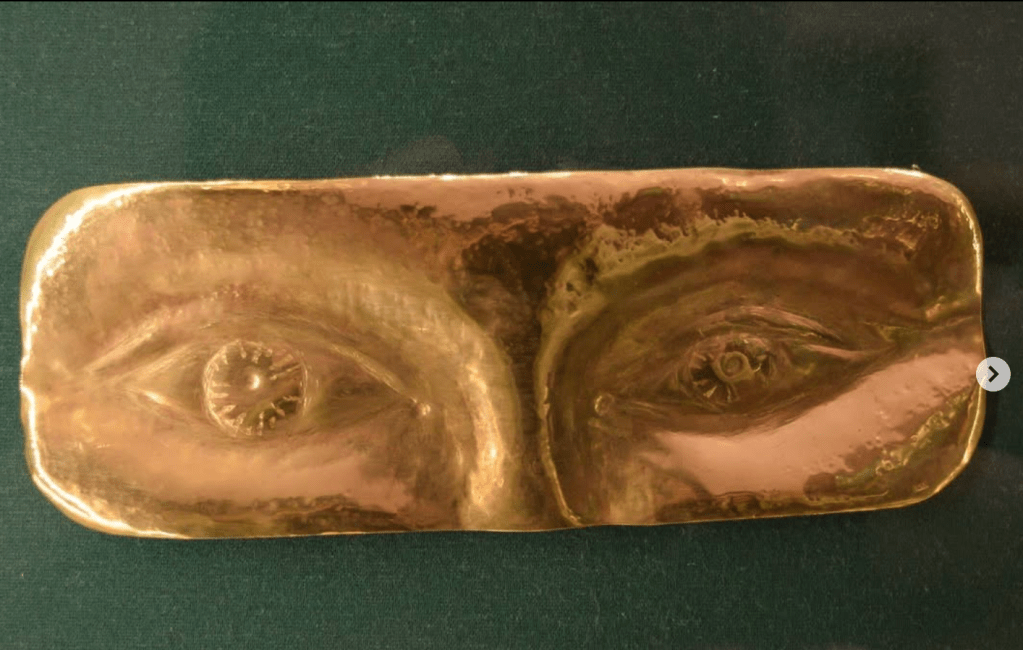
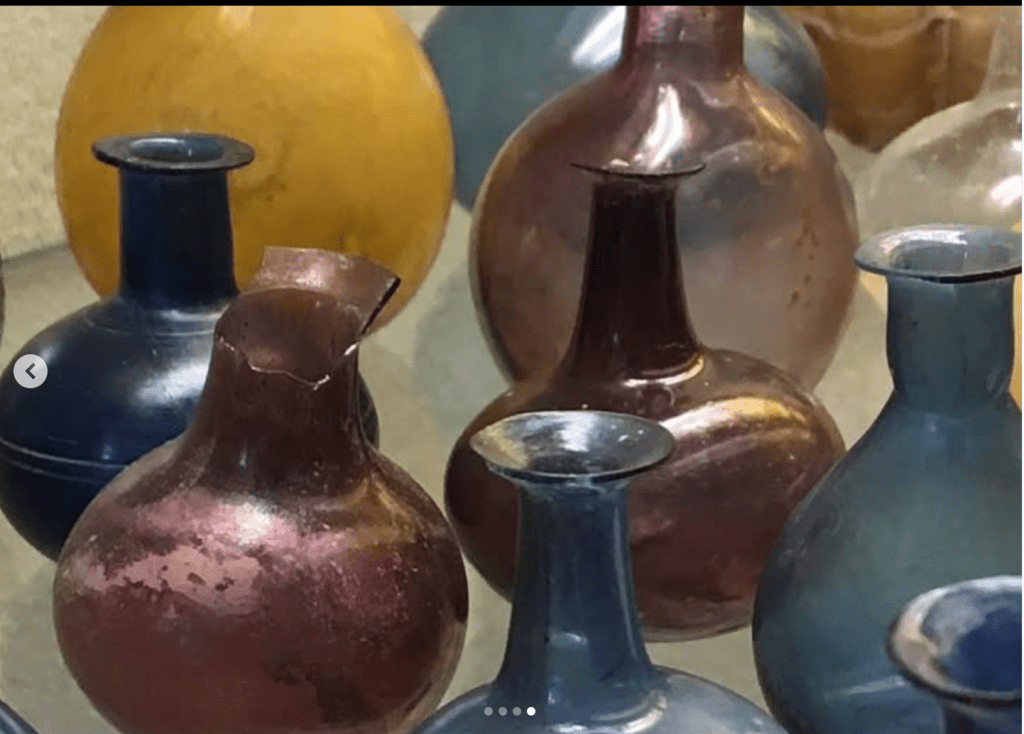
Images: 1) St. Lucy ex voto, Siracusa 2) burning candles 3) eyes of Roman statue head in Museo Nazionale, Roma 4) Roman glass, Aquileia.

Aristotle and Transparency

Originally posted on Instagram on 8/10/24.

Aristotle discusses color in two main texts, On the Soul and On the Senses. There is a text titled On Colors attributed to him, but it is likely by a follower. On Colors begins with an affirmation of Empedocles’ insight on the connection between the four elements and colors, whereas in On the Soul and On the Senses Aristotle articulates a more dynamic view of color, imho.

For Aristotle color fills and makes visible the transparent. The idea of transparency may seem odd when thinking about color, since we generally equate transparency with lack of color. However, for Aristotle, color by its very nature, color “can produce movement in that which is actually transparent.”

There is some disagreement about how Aristotle understands transparency. He might just mean things like water, air, and solid objects like glass and crystal. But professor of ancient philosophy Katerina Ierodiakonou notes that in On the Senses Aristotle implies that all objects can be understood as transparent and that color fills the transparent in a way that the boundaries or limits of an object can be seen. The color makes the limits of a defined object apparent.

In the case of things that are undefined and more transparent, such as water or air, a person can see brightness and/ or darkness. These qualities, which Aristotle identifies as color, shift depending upon the viewer’s distance from them, their depth, etc. In some sense, more transparent things, which hover between brightness and darkness, help us recognize that all colors are a mixture of light and dark. As Ierodiakonou explains, for Aristotle objects that are more transparency appear white, since they allow in some brightness (fire and air), while objects that are not at all transparent appear black. 

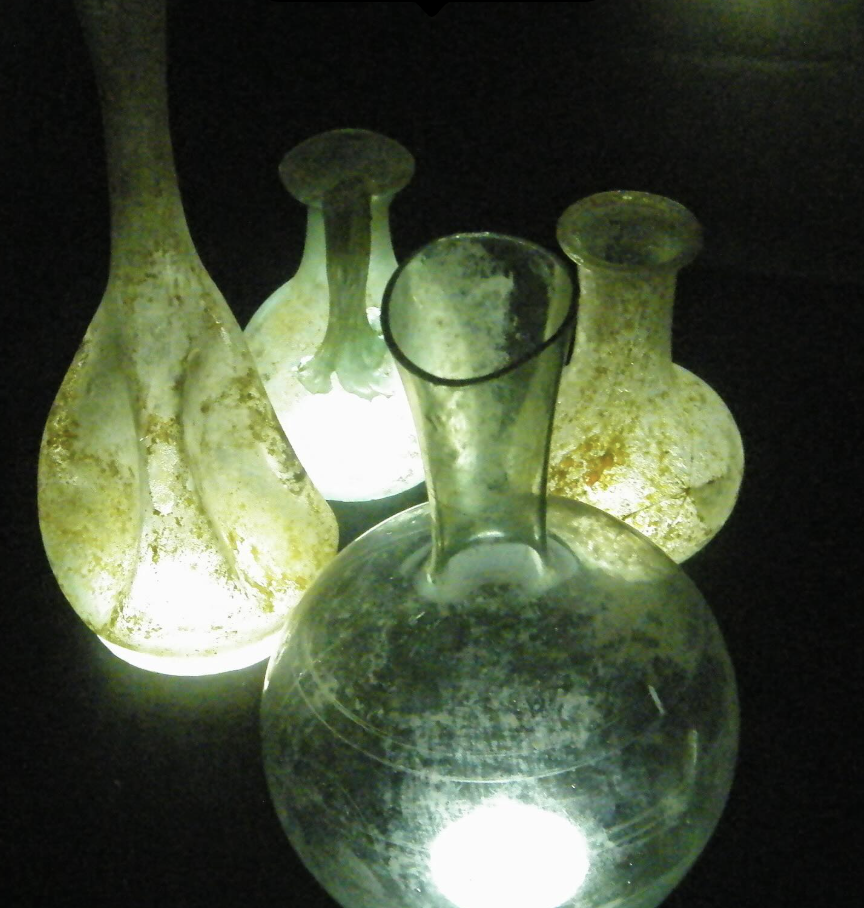
Images: 1) Roman Glass from Pompeii (Naples Arch Museum); 2) Crystals. Cefalu, Sicily. 3) A Roman glass vessel in the shape of a fish that is yellowish in color. British Museum. 4) Brightness and darkness in transparent colored glass. Bodrum, Turkey. 5) White agate intaglio with Athena and Mercury, Istanbul Arch Museum.

Empedocles on Color

A version of this was posted on Instagram 8/7/24.

One of the first Greek philosophers to discuss color is Empedocles (c. 484-424 BCE) from Akragas (aka Agrigento) in Sicily. Unfortunately, with the exception of a possible fragment of his work Physika, his work comes to us primarily via citations by others. There are modern collections of work related to E. (including in a Loeb volume) including accounts of his life and teaching, citations of his works, and interpretations of or commentary on his work.

Among the most important ideas attributed to E. is the notion that all things are comprised of four roots or elements—fire, earth, air, water. These elements contribute to the color of things.

At least one ancient author quotes E. as identifying four colors (black, white, red, yellow), which would correspond neatly to the four elements. However, elsewhere in his extant writing E. only refers to black and white, linking them to water and fire respectively. Ironically these are not considered colors, strictly speaking, within the Newtonian understanding of color. However, they are fundamental to ancient color theory.

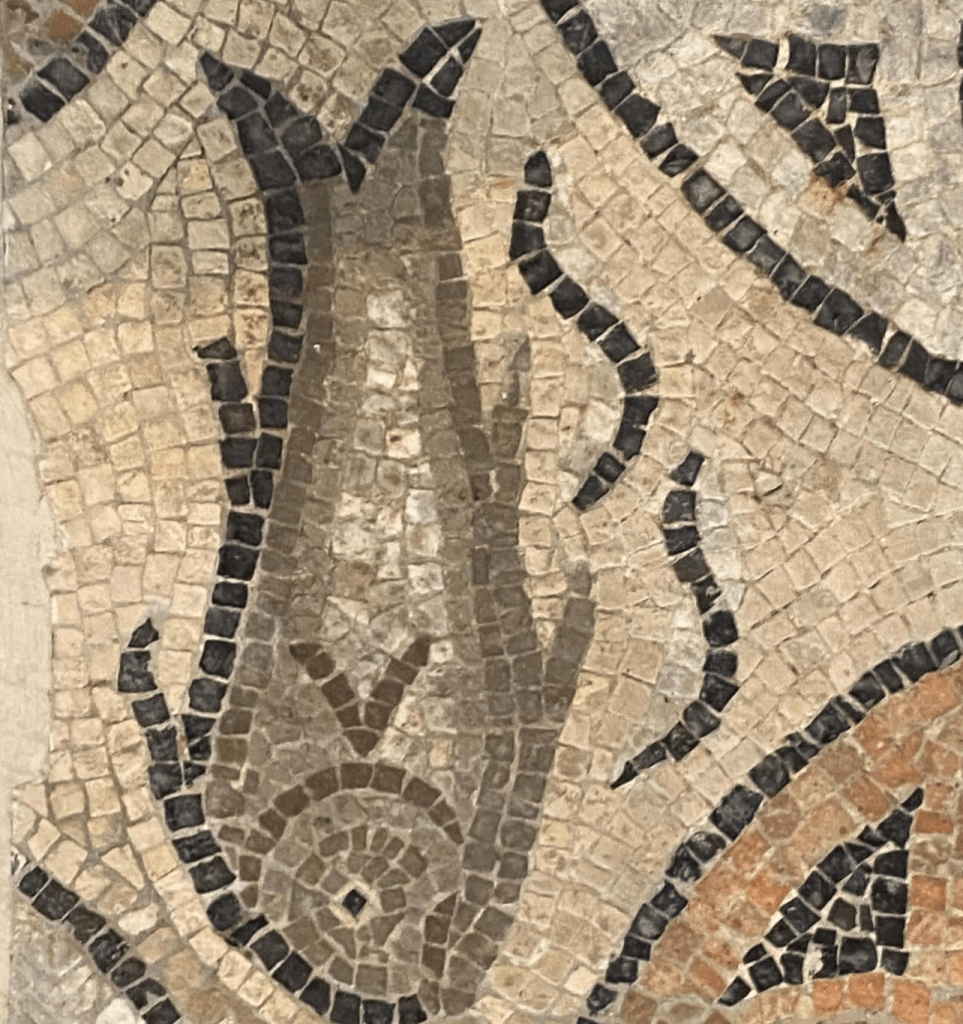
E. compares the creation of things from the elements to an artist who “mixes” colors. Professor of ancient philosophy K. Ierodiakonou explains that “mixing” should not be understood like blending. Rather, it refers to putting colors side-by-side. In some sense, this is similar to how the tiles of a mosaic are laid next to each other. Mosaicists were able to create the illusion of shading the this way. In other words, the elements that make up matter are not diminished or diluted when mixed to create another thing. For instance, E. explains that bones are 4 parts fire, 2 parts water, and 2 parts air. Because they are mostly fire, they appear white.

Images
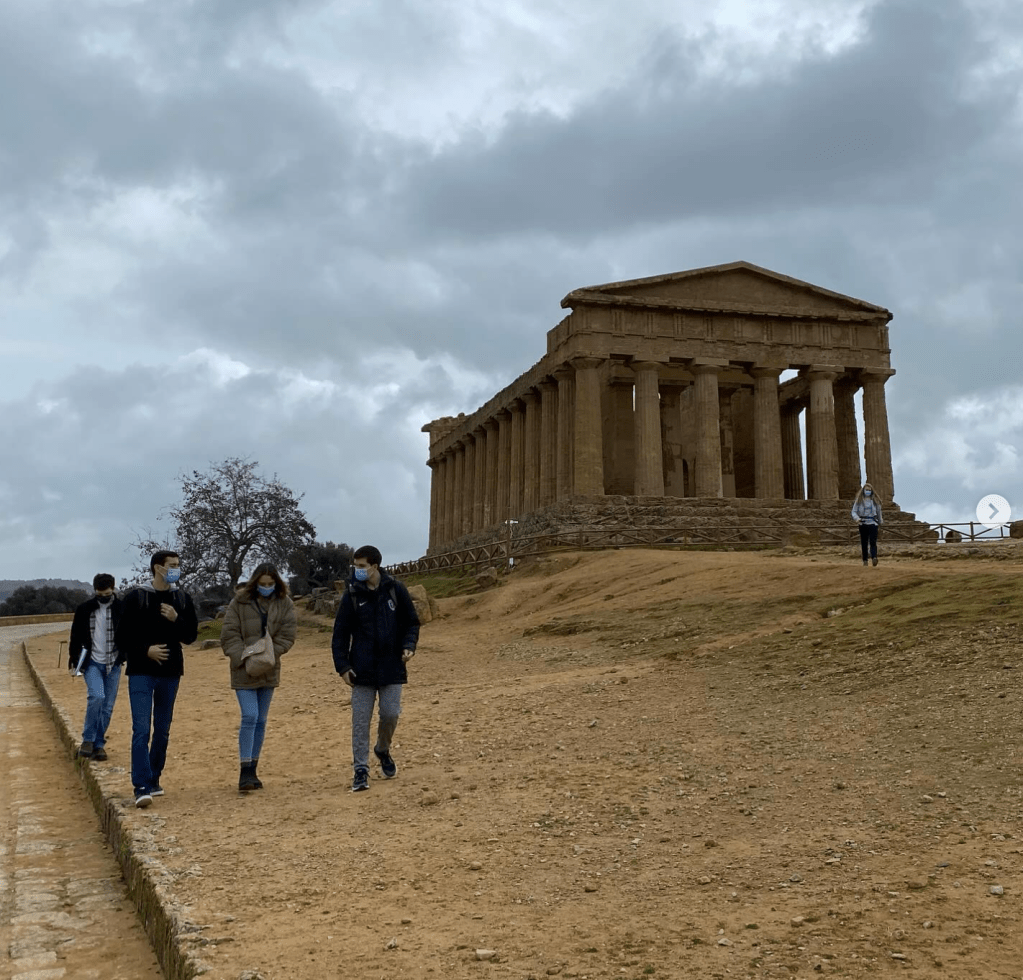
1) skeleton mosaic from Pompeii; 2) a simple mosaic of a fish shows how placing different color tiles next to each other creates the illusion of dimension; 3) mosaic floor from Pompeii with the four colors supposedly mentioned by Empedocles; 4) classical Greek temple in Agrigento.

Revelation in Color-Pinned Post

I’m currently working on a book project on Revelation and I’m hoping to use this venue as a tool for articulating and organizing my ideas. This work is preliminary, although I hope that some of the ideas I present here will be original and, consequently, I ask that you cite me if you use them in any academic work. TIA.

The project is on Revelation’s color symbolism and how it intersects with both ancient thinking about skin color and people groups (think Benjamin Isaac’s idea of “proto-racism” in antiquity) and how modern interpreters (academic and more popular) deploy this in racialized ways. Specifically, I am interested in bringing to the fore how Revelation has been used in support of Whiteness and anti-Black racism. I think this is especially important in the present moment, as some sectors of the population, especially in the US, are doubling down on White Christian Nationalism.

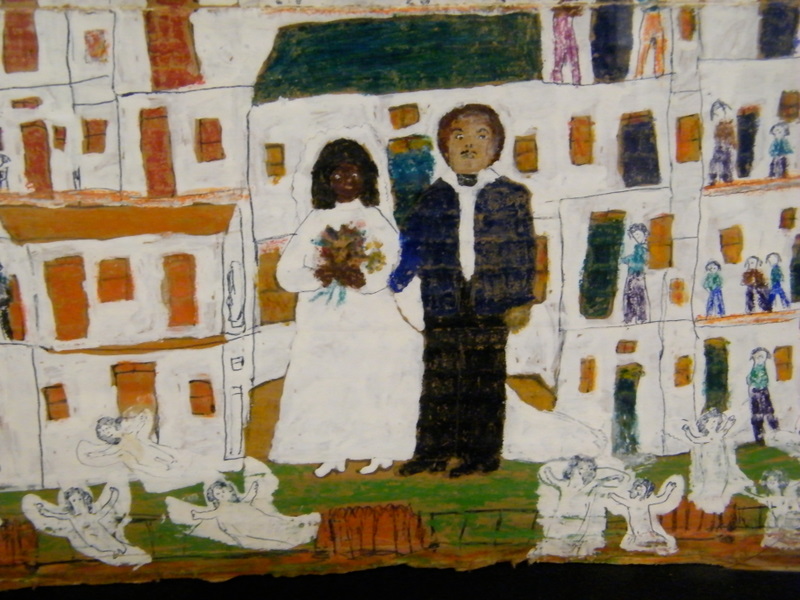
A crayon and pencil drawing of a Black woman in a white wedding dress stands with a White man in a black suit. They are in front of a an apartment building with lots of small figures around them.
Detail from a Gertrude Morgan illustration of the New Jerusalem, n.d. From the Louisiana State Museums.

One of the images (or set of images) I am thinking about as I embark on this project is Gertrude Morgan’s depiction of herself as Bride with her Bridegroom Christ. She has multiple representations of this, including this one from the New Orleans Museum of Art. I briefly mention this White Jesus in Thinking and Seeing with Women in Revelation (Bloomsbury 2013). I don’t really do enough with it there, since I wasn’t thinking explicitly about race (which I think is a problem). Even though this present project is not about Morgan’s work specially, these images will be in my mind as I write.

In a future post, I’ll say a bit more about color and Revelation’s image of God/ Christ.