
Action Figure Trend, but #FuckAI

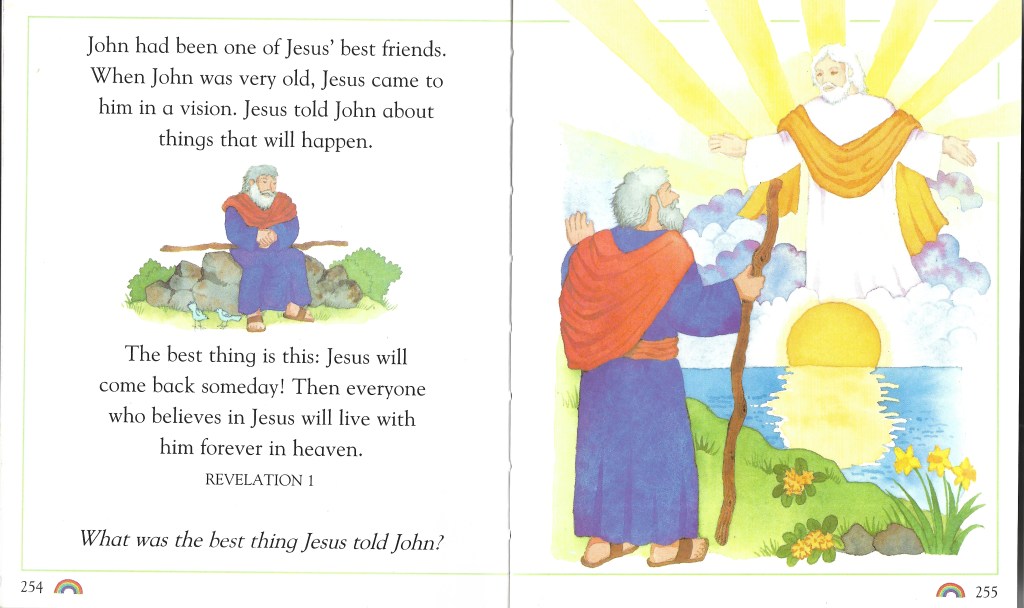
I’m currently looking at illustrated Bibles to understand how Revelation’s throne room is depicted visually. In the process, I stumbled across a visual representation of one of my favorite Revelation “side quest” topics-John’s status as Jesus’ beloved as a reason behind Revelation.
As you may or may not know, the Fourth Gospel, long believed to have been authored by John, references a “disciple that Jesus loved” (20:2; 21:20). This disciple is the one who reclines on Jesus’ breast at the Last Supper, and from the cross, Jesus establishes a familial connection between his mother and the beloved, an in-law kind of relationship (19:26-27). Finally, the “beloved disciple” claims gospel authorship in 21:24.
Even though the gospel does not use the term used for “beloved” in ancient Greek homoerotic/ pederastic relationships, the language can be read in erotic terms. Put another way, the text potentially gestures toward a romantic relationship between Jesus and the disciple.

As discussed by medievalist Jeffrey Hamburger in his book St. John the Divine: The Deified Evangelist in Medieval Art and Theology (2002), some medieval traditions add to this by suggesting that the Wedding at Cana, where Jesus turns water into wine, is John’s wedding. However, John ditches his betrothed to follow Jesus in virginal devotion. This tradition is visually evoked in depictions of John as young or virginal. People often think he looks like a woman, as in da Vinci’s Last Supper, where people (ahem, Dan Brown) have confused John with Mary. Nope. John is simply depicted as Jesus’s beloved or younger lover.*
And, here is where Revelation comes in . . . some medieval interpreters believe Jesus grants John the Revelation because of this closeness. Revelation is a gift from lover to beloved.
I’d mostly considered this a medieval tradition, but I found it referenced in an illustrated Bible from 1889, written by Louise S. Houghton and published by the American Tract Society. You can find the Bible on the Internet Archive (see below).

Moreover, the story of John being Jesus’s “special friend” as a reason for John’s visionary experience finds its way into at least one contemporary children’s Bible. Hmmmm . . . .
*If you find the medieval traditions about John and Jesus interesting, check out Hamburger’s book or take a look at my book Thinking and Seeing with Women in Revelation (2013).
I’m currently working on a book project on Revelation and I’m hoping to use this venue as a tool for articulating and organizing my ideas. This work is preliminary, although I hope that some of the ideas I present here will be original and, consequently, I ask that you cite me if you use them in any academic work. TIA.
The project is on Revelation’s color symbolism and how it intersects with both ancient thinking about skin color and people groups (think Benjamin Isaac’s idea of “proto-racism” in antiquity) and how modern interpreters (academic and more popular) deploy this in racialized ways. Specifically, I am interested in bringing to the fore how Revelation has been used in support of Whiteness and anti-Black racism. I think this is especially important in the present moment, as some sectors of the population, especially in the US, are doubling down on White Christian Nationalism.
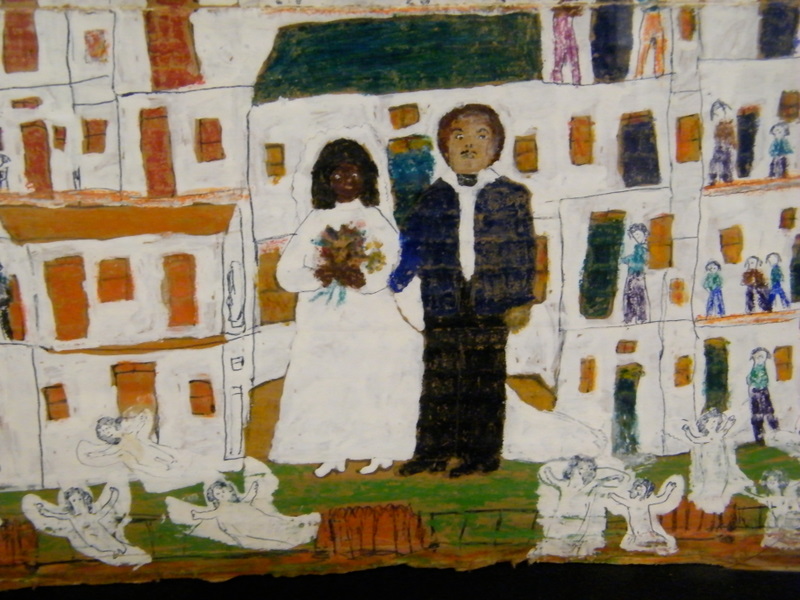
One of the images (or set of images) I am thinking about as I embark on this project is Gertrude Morgan’s depiction of herself as Bride with her Bridegroom Christ. She has multiple representations of this, including this one from the New Orleans Museum of Art. I briefly mention this White Jesus in Thinking and Seeing with Women in Revelation (Bloomsbury 2013). I don’t really do enough with it there, since I wasn’t thinking explicitly about race (which I think is a problem). Even though this present project is not about Morgan’s work specially, these images will be in my mind as I write.
In a future post, I’ll say a bit more about color and Revelation’s image of God/ Christ.
 Lynn R. Huber